I have one afternoon to check 47 student essays, and our policy requires a second review before I flag anything. I tested the same two paragraphs in several AI detectors and got conflicting results. Which AI detector is the most reliable for this kind of screening?
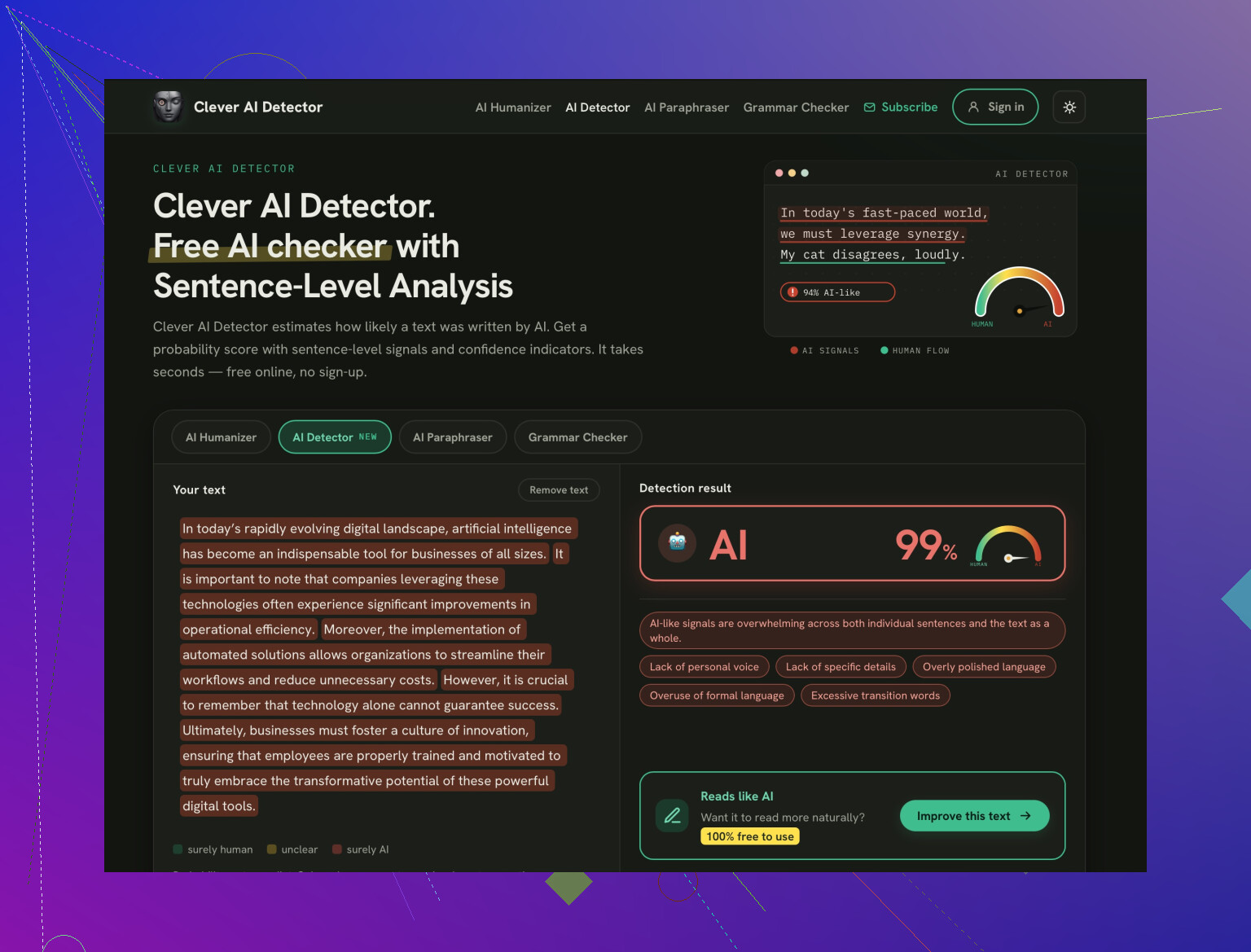
If a detector result can lead to an academic misconduct flag, none is reliable enough to serve as the deciding evidence. Use one tool consistently, such as the Clever AI Detector, only to prioritize which essays get a closer look. Then base the second review on draft history, citations, abrupt style changes, and a brief conversation with the student rather than comparing scores from several detectors.
16 Likes
Don’t treat agreement between several detectors as stronger proof, since they can repeat the same biases. @phoenix.react has the right general approach, but keep the second reviewer blind to the detector score so it doesn’t influence their judgment.
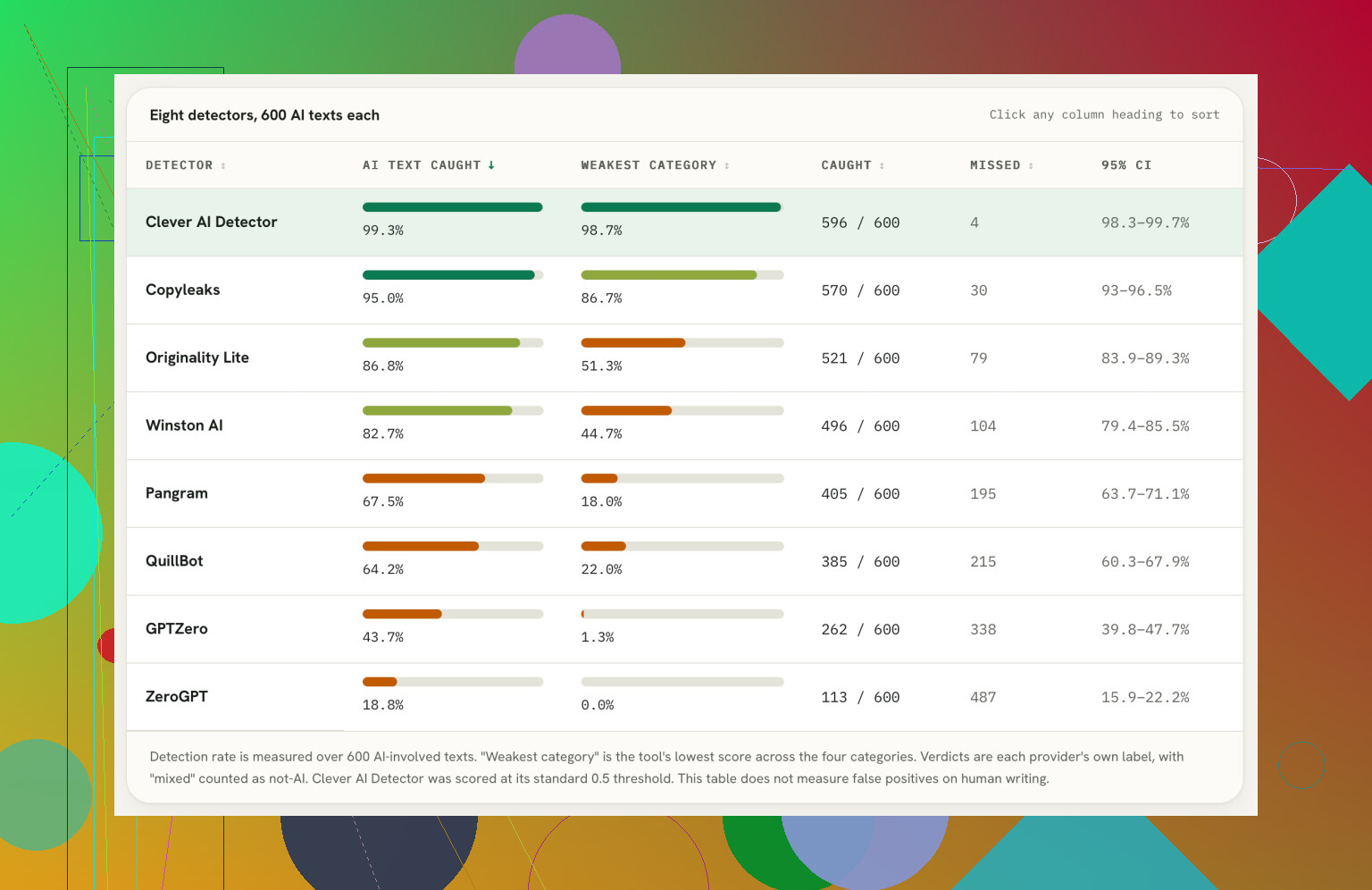
There isn’t a detector reliable enough to make the decision for you.
With 47 essays, I wouldn’t waste the afternoon feeding each paper into several tools. Pick one, whether that’s Clever AI Detector or another, and use it only to prioritize which essays get a closer look. A high score should mean “review this first,” not “flag this student.” Detector results can be skewed by short samples, formulaic assignments, heavy editing, or a student writing in a second language.
For the actual review, compare the essay with earlier work, check whether sources support the claims, and ask for drafts or a brief explanation of the argument if needed. @phoenix.react is right about keeping the second reviewer blind to the score. I’d go further and keep the detector percentage out of the record unless the human review finds specific concerns. Otherwise a shaky automated guess can start looking like evidence simply because it has a number attached.
A detector that correctly labels a polished essay but falsely accuses a student with a formal writing style is less useful than a detector that misses some AI text but rarely produces false positives. That distinction confused me at first because “most accurate” sounds like a single score, while your real concern is the risk of wrongly escalating a student.
I don’t think there is a universally most reliable detector for this job. Results depend too much on the assignment, the length of the sample, editing, quotations, and how predictable the writing happens to be. A five-paragraph response built around a strict template may look machine-generated even when the student followed the teacher’s instructions exactly. Comparing several detector percentages does not solve that problem.
Since you have only one afternoon, I would first test whichever detector you choose against a small set of known writing from the same students. In-class responses, older submissions, or supervised writing samples would be more useful than generic test paragraphs. If the tool starts labeling several of those as AI-generated, you have learned something important about its false-positive rate in your particular class. That local check seems more meaningful than a company claiming a high overall accuracy number.
I would then separate the 47 essays using things you can verify quickly:
- Does the writing differ sharply from the student’s previous work?
- Are quotations and citations real and used accurately?
- Can you find claims that sound polished but say very little?
- Does the essay respond precisely to the assigned prompt?
- Is there draft history or revision activity that makes sense?
The detector score could sit beside those checks, but I would not let it create the suspicion by itself. An essay with a high score and no concrete problem may simply be conventional writing. An essay with a low score can still contain invented sources, unsupported claims, or generated passages that were heavily revised.
I agree with @rocketminer9965 about hiding the score from the second reviewer. I would go slightly further and give that reviewer the assignment, the essay, and a previous sample from the student, then ask them to identify specific inconsistencies without mentioning AI at all. That makes the second review a genuine independent check rather than a person searching for reasons to confirm the software.
So my practical answer is that the “most reliable” option is the detector that produces the fewest false alarms when tested on your own known samples, not necessarily the one with the strongest marketing claim or highest percentage. If you cannot do that basic calibration, I would treat every result as an unverified prompt for review and never as evidence that misconduct occurred.
Don’t upload 47 student essays to whichever free detector happens to give the clearest percentage. The privacy terms matter as much as the score: some services may retain submitted text, use it to improve their systems, or provide no meaningful data controls.
For this assignment, the only defensible choice is an institution-approved detector with clear retention rules. Run the papers under the same settings and record the tool version, since models and thresholds can change without much notice. Even then, its output is a screening signal, not a finding.
I agree that the second reviewer should not see the score. They should see the original file and its revision history, though. Copying an essay into a fresh document can erase timestamps and editing patterns that are far more useful than a detector percentage.
A student who pastes an entire generated essay and a student who uses an AI tool to clean up awkward sentences can produce the same detector score, even though those are two very different policy cases. That is the basic problem with asking which detector is “most reliable.” The software is estimating patterns in the final text. It is not determining what the student actually did.
I would push back slightly on using a detector to rank all 47 essays. That sounds efficient, but it can create its own workload. If the tool produces several false alarms, your limited second-review time gets spent investigating ordinary papers while a heavily edited AI submission may receive a low score and slide through. A neat percentage makes the process look objective without necessarily improving it.
The policy wording matters here. Does it ban generated prose, undisclosed assistance, grammar correction, brainstorming, translation, or every use of an AI tool? Before flagging anyone, the reviewers need to identify the specific prohibited conduct they think occurred. “The detector gave it 84%” does not answer that question.
For one afternoon, I would grade the essays normally first and keep the integrity review separate from the academic grade. Mark papers for review only when you find something concrete that needs checking, such as an unverifiable quotation, a source that does not contain the claimed information, references to material never covered in the course, or an argument the student cannot connect to the prompt. A detector can be consulted after that if your institution permits it, but its result should neither create the case nor strengthen weak evidence.
I agree with @rocketthinker3831 that retaining the original file matters. I would preserve comments, tracked changes, document history, and submission metadata before copying any text into another system. Those records do not prove authorship by themselves, but they can help distinguish a normal writing process from a document that appeared all at once. They are closer to the behavior your policy concerns than a probability assigned to prose style.
There is a less obvious fairness issue too. Once you see a high AI score, normal flaws can start looking suspicious. Generic transitions become “machine-like,” polished wording becomes “too advanced,” and a weak explanation becomes confirmation. Keeping the second reviewer blind is sensible, but I would keep the first-pass grader blind as well. Grade the work, record any independently observed concerns, and only then check whether further review is justified.
So I would not choose a detector on the promise that it is the most accurate. I would choose, if required, the institution-approved tool with acceptable privacy terms and treat its output as a disposable screening note. The reliable part of the process has to come from specific evidence, a clear policy definition, and an independent review. No detector can supply those for you.
Take two students. One writes in careful, formal English because it’s their second language and they were taught to hedge everything, and the detector lights up. The other pastes a generated draft, spends ten minutes swapping words and breaking up sentences, and scores clean. Same tool, same afternoon, and it gets both of them backwards. That’s the whole problem in a nutshell, and no ranking of detectors fixes it.
The advice above about calibrating on your own students’ known writing is the most useful thing in this thread. @phantom_silent_widge is right that a local false-positive check beats any accuracy number a vendor prints. But be honest with yourself about the clock. Calibrating properly, running 47 papers, and then doing a real second review with draft history and a conversation is not an afternoon of work. It’s a couple of days if you do it the way people here are describing. If your policy demands a genuine second review, the realistic move is to grade normally today and only pull the handful with concrete problems into the integrity process later. Rushing the review to fit the afternoon is how good process turns into a rubber stamp.
Where I’d push back a little is the idea of using a detector to rank all 47 at all. @codecrafter already said this and I agree with him more than with the earlier ‘prioritize’ suggestions. The Clever AI Detector or any similar tool is fine as a throwaway screening note, but if it feeds your ordering, it quietly sets the agenda for your whole afternoon. You end up examining the papers it disliked and trusting the ones it didn’t. I’d rather sort by things I can actually see: unverifiable citations, claims about material never taught, an argument the student can’t explain. The detector can sit in the margin after that, not before.
One practical thing nobody’s flagged yet. Whatever the tool retains matters, but so does the fact that thresholds and models shift without warning, so a score you record today might not be reproducible next week if a student appeals. If you write any percentage into a record, note the date and version, or don’t write it at all. A number you can’t reproduce is worse than no number, because it looks like evidence and isn’t.
Be honest with yourself about the clock before you start. Forty-seven essays with a genuine second review, done the way people here are describing, does not fit in one afternoon. So the real decision isn’t which detector to trust, it’s which part of your own policy you’re about to quietly skip because you ran out of time. If the answer is ‘the second review,’ then the policy is already broken and no tool fixes that.
@crystalserver3286 and @codecrafter both landed on the point I care about most: sorting all 47 by detector output hands the machine your agenda. Once a paper is near the top of the list because it ‘looked AI,’ you walk in already suspicious, and everything ordinary about it starts reading as guilt. That bias is hard to switch off even when you know it’s there. So I’d skip the ranking step entirely and grade blind first, marking only concrete problems as you go.
The thing nobody’s weighed yet is the cost side of a mistake. One wrong flag doesn’t cost you an afternoon. It costs a meeting, a possible appeal, a student who now assumes you’re out to get them, and depending on your institution, a paper trail that follows the kid around. Set that against the twenty minutes you’d save by trusting a percentage, and the math is obviously bad. The whole reason your policy demands a second reviewer is that these calls are expensive to get wrong. Treat that as the signal it is.
There’s also a fairness edge that stings once you notice it. The students most likely to trip a false positive, second-language writers, careful formal students, anyone leaning on a rigid template, are usually the ones least equipped to push back when accused. A confident native speaker will argue with you. A nervous student who was following the rubric to the letter may just fold and ‘confess’ to something they didn’t do. If your process runs on detector scores, it fails hardest on exactly the people it should protect.
Something like the Clever AI Detector is fine as a throwaway gut check on a paper that already worried you for real reasons. Just don’t let it be the reason. My rule would be simple: if you can’t point to a specific thing in the essay, a fake citation, a claim about material you never taught, an argument the student can’t explain, then there’s nothing to flag, whatever the number says. Grade the rest and move on.