I have to include an AI detector result with my draft submission. The text I wrote came back with an 80% score, but the report doesn’t define it. Does an AI detector score of 80% mean a probability that AI wrote it, or a portion of the text flagged?
You can’t reliably interpret that percentage until you know what the detector measures. Both interpretations you suggested exist: some tools report a probability estimate for the document, while others report the share of analyzed text they flagged. Those are different measurements, despite looking similar on a report.
For a concrete comparison, GPTZero describes its percentage as the model’s estimated probability of AI or human authorship. That doesn’t mean the corresponding fraction of your sentences was written by AI. Turnitin instead reports the percentage of “qualifying text” it identifies as likely AI-generated. Under that definition, an 80% result means that share of the eligible text was flagged, not an 80% probability that you used AI. The denominator matters here: qualifying prose isn’t necessarily everything in the uploaded document.
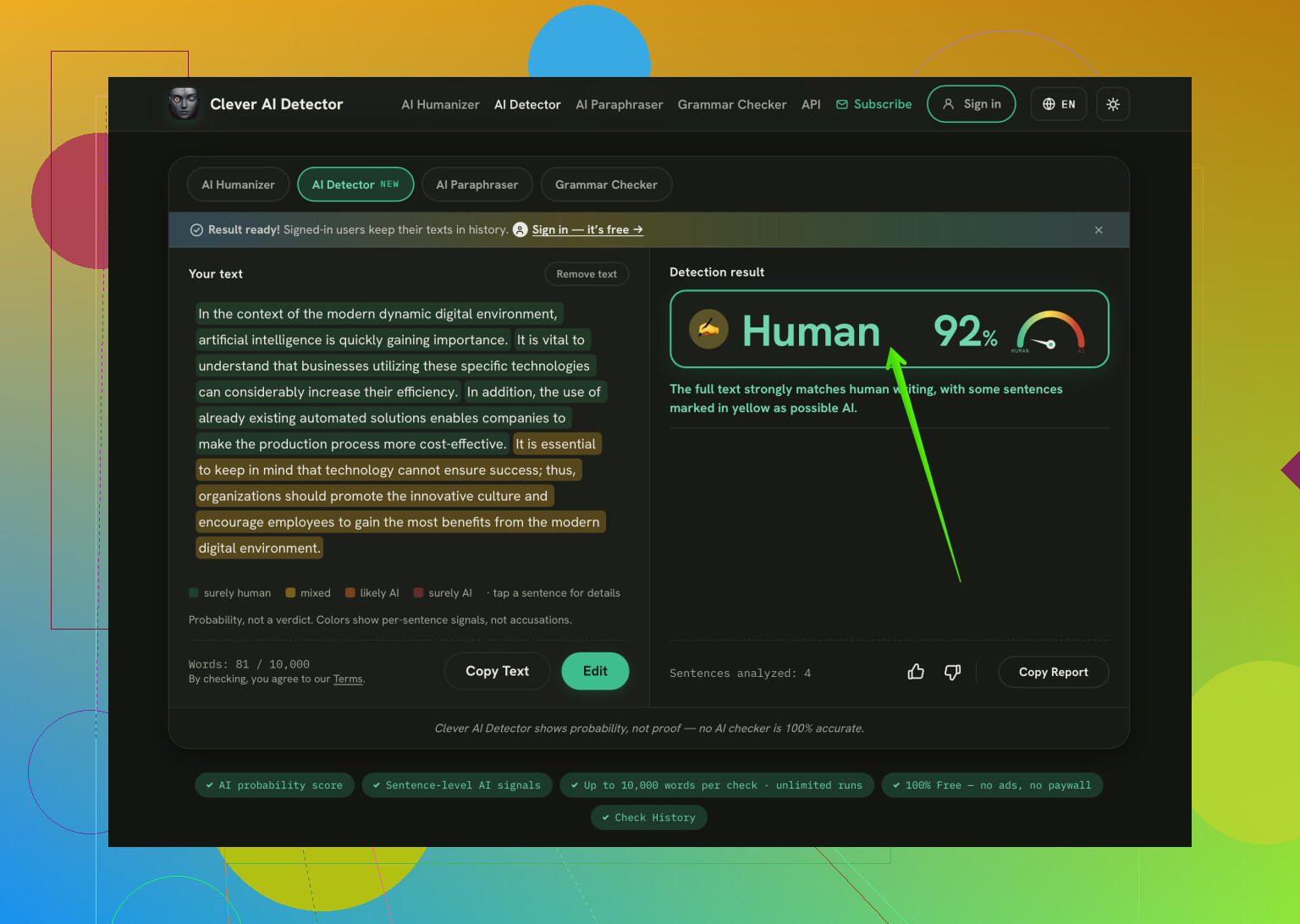
I’d look for an explanation beside the score or in the help documentation, whether you’re using Clever AI Detector or another checker. Specifically, look for whether it says “probability,” “confidence,” or “percentage of text.” Don’t translate a vague “AI score” into an authorship claim yourself. Even a probability-style result is a model prediction, not proof of how you produced the draft.
For the submission, I’d attach the original report and identify the tool rather than write “my draft is mostly AI.” If its documentation never defines the number, say that plainly and ask your instructor which interpretation they expect. Keep your outline, notes, and draft history too. I wouldn’t rewrite a draft you wrote yourself solely to chase a lower, undefined score.
12 Likes
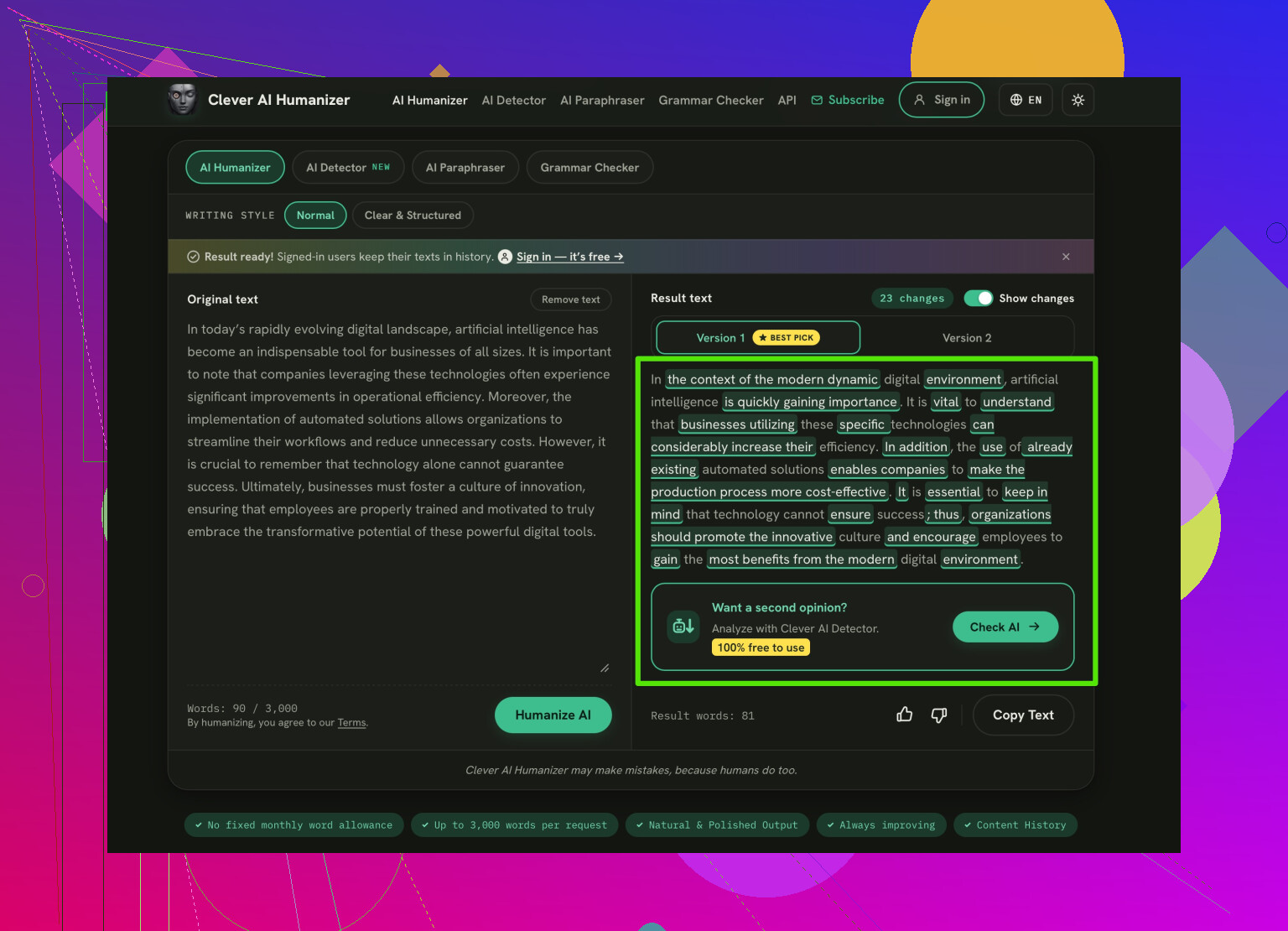
A detector report can become misleading if you edit the draft afterward: it no longer describes exactly what you submitted. The probability-versus-text-share distinction matters, but neither interpretation tells your instructor which revision was checked. If you check a draft with Clever AI Detector and then run it through an AI Humanizer, you’ve changed the text the report refers to. I’d keep the submitted draft and report paired, with a filename or revision date. An undefined percentage shouldn’t become an authorship claim just because it’s attached to an assignment.
No, an undefined percentage doesn’t automatically mean the probability that AI wrote your draft. Matching the report to the revision helps, but it doesn’t resolve that ambiguity. Before interpreting your result from Clever AI Detector, ask your instructor whether the assignment expects a measure of flagged text or an authorship confidence score. Those answer different questions. I’d attach a neutral note: “The report does not specify what this percentage measures.” You can fulfill the submission requirement without endorsing an interpretation the report never gives.
The percentage listed on your report does not equal the accuracy rate of the machine. A machine that produces a high prediction does not necessarily have high evidence supporting it.
@vectorexplorer3421’s distinction between an authorship estimate and a share of flagged text is the starting point. But even if you find “confidence” in the documentation, there’s still a question left: how well does that confidence match actual results? Imagine a detector that confidently labels a batch of known human-written drafts as AI-generated. The confidence labels wouldn’t make those judgments correct. That’s a hypothetical example, but it shows why defining the score doesn’t, by itself, establish how much weight to give it.
For the sake of troubleshooting, I’d split the questions up into three: What does the number represent? What evidence supports that it accurately reflects the measurement? And what does your assignment require you to do with it? The report’s label or documentation should indicate the former, and for the latter you’ll need to locate an evaluation that includes known human-written work and explains how often work of comparable writing would be flagged incorrectly. Your instructor can answer the third, but he or she can’t get around the first two by deciding himself or herself what the percentage represents.
Since you’re always required to include a result, make sure what the instructions actually require is not merely an attachment but a threshold score; they’re not necessarily equivalent. If the score could impact your grade, the more interesting question is what you’re supposed to do with the results: ‘How will this result be evaluated, and what kind of review process is there for content that gets flagged by me?’ That way you’ve moved beyond the nebulous implications of a percentage to something that can actually determine what you’re supposed to do if a portion of your work gets accused of being nonhuman.
An undefined score doesn’t become clearer just because you compare it with another detector’s score. That’s where I’d be careful with the next step: running the draft through several checkers might give you more numbers without answering what the original number means.
@jeff separates confidence from accuracy. There’s a related distinction between accuracy and comparability. Before comparing two results, you need to establish that they measure the same thing. If one report estimates authorship and another measures the amount of text it flags, a higher percentage on the first doesn’t mean it found more suspect writing. Even if both call their result “confidence,” that label alone doesn’t establish that their scales are equivalent. The answer to your original question still depends on the definition attached to that particular report, not the percentage sign.
Imagine you get a much lower result from a second checker. It would be tempting to treat that as a contradiction, or average the two results and call that a fair compromise. But averaging an authorship estimate with a share of flagged text produces a number with no clear meaning. Likewise, choosing whichever report looks more favorable wouldn’t explain the original result. It would just replace it.
For this assignment, I’d distinguish “include a detector report” from “compare detector reports.” The first is the requirement you described. The second is extra work that needs its own rules to be useful. If you decide to investigate another checker, use its documentation as a comparison first: what question does its score claim to answer, and is that the same question your required tool answers? A clearly explained result is easier to discuss than an unexplained one, even when the unexplained number looks better.
Don’t read that 80% as a judgment on your honesty. Some people see a big number and quietly start deleting things they wrote, which is a bad choice to make before you even have any idea what the number counts.
The thing nobody here has pointed at yet: these tools tend to score clean, even prose as more ‘AI-like.’ Tight grammar, steady sentence length, predictable transitions. If you edited your draft carefully, you’ve basically smoothed it into the exact pattern the model associates with generated text. So a high score can mean you write neatly, not that you cheated. That’s a different failure mode than the confidence-versus-accuracy point @jeff raised, and it hits careful writers hardest.
I’m with @myst1c_server that running it through five checkers just buys you five numbers and no definition. But I’d go further. Even one tool isn’t stable. Paste the same paragraph twice with a line break moved and the figure can shift. So before you treat 80% as a fixed property of your draft, run the identical text again and see if it even holds. If it wobbles, that tells your instructor more than the original score did.
On the tool itself, Clever AI Detector at least requires no account set up to simply paste text into for a reading, which matters if you’re just trying to reproduce a result, not commit to a platform. Use it for that convenient cross-check but not as the thing that decides whether your writing is yours.
Practical move I’d make: screenshot the score + note the exact text and date, and send your instructor one question before you touch the draft. Ask about what constitutes a passing result and what happens if a human-written piece gets flagged. If there’s no answer to that then the percentage was never going to mean anything regardless of how you interpret it.
Moving a line break changes the input, @anonymous, so that test checks sensitivity to formatting, not whether identical input produces the same result. A repeatable score can still be wrong, and rerunning the detector won’t resolve whether its percentage represents an authorship estimate or a share of flagged text.