I’ve been testing Phrasly AI’s Humanizer for content polishing and I’m not sure if it’s actually improving readability or just rewording things. I need help understanding its real pros and cons for SEO content, blog posts, and more authentic-sounding copy. Has anyone used it long-term and can share practical results or suggestions for better alternatives?
Phrasly AI Humanizer review, from someone who hit the limit in 5 minutes
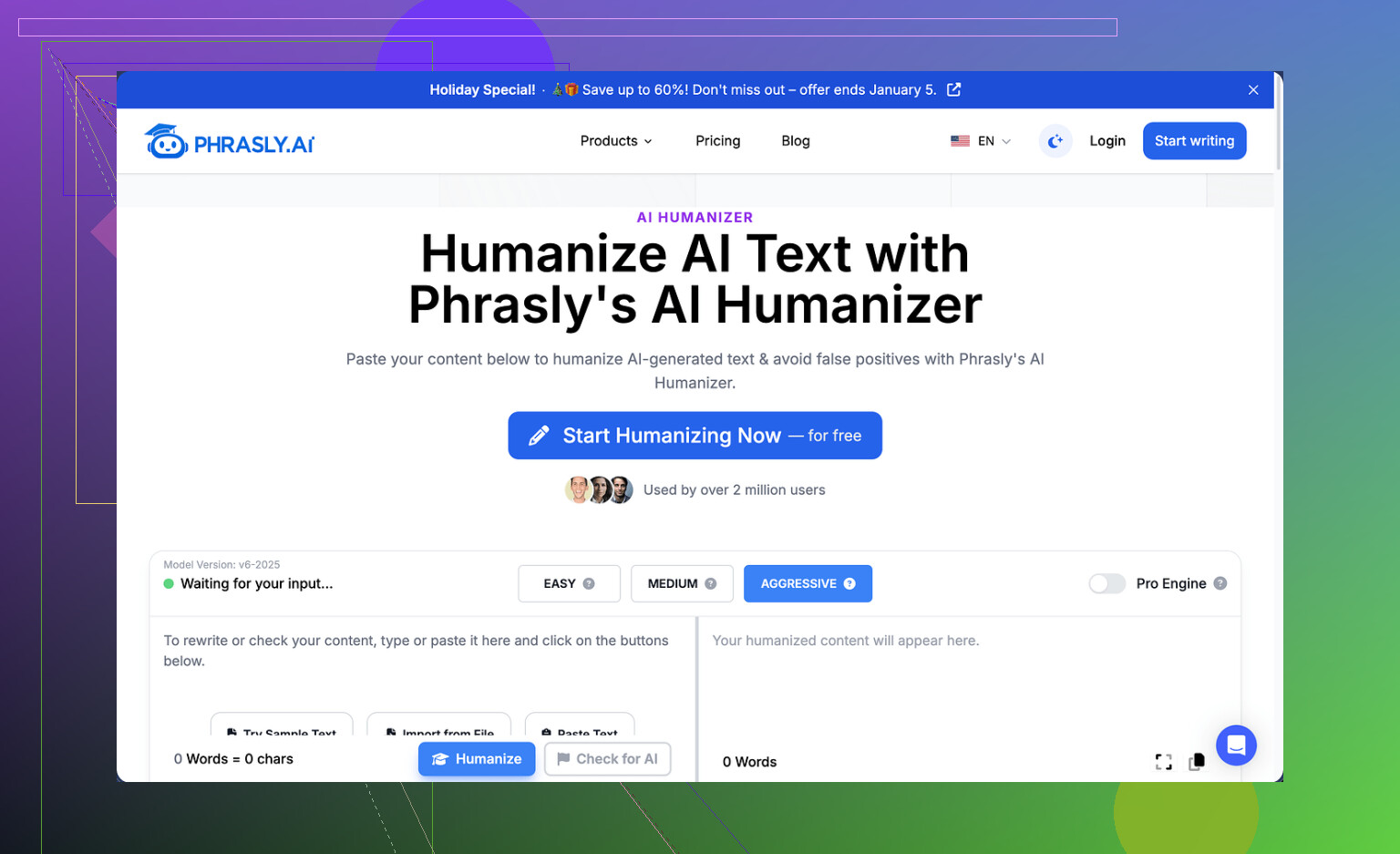
I tried Phrasly here: Phrasly AI Humanizer Review with AI-Detection Proof - AI Humanizer Reviews - Best AI Humanizer Reviews
Ran into a wall right away.
They give you 300 words total on the free plan. Not per day. Total. After that, your IP is blocked from making fresh accounts, so there is no quick workaround for extra testing.
I usually run three different samples through tools like this. With Phrasly, I managed one.
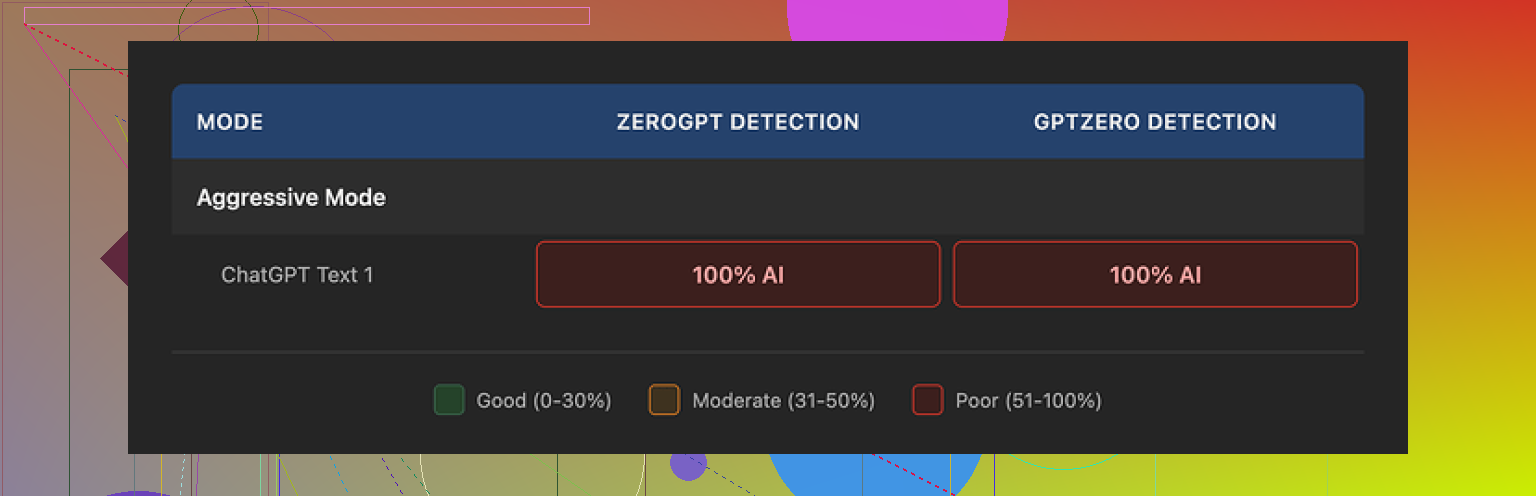
That one run failed hard. Both GPTZero and ZeroGPT flagged the output as 100 percent AI. I set the strength to Aggressive, which their own UI says is the best choice for detection bypass. The scores before and after humanizing looked the same.
So from an “avoid AI detection” angle, the free engine did nothing for me.
How the output text looked and felt
To be fair, the text it produced did not look broken.
The humanized output:
• Read smoothly
• Stayed grammatically clean
• Kept a steady academic tone
If you are trying to pass a rubric that checks writing quality only, you might not hate it.
The problems start when you look closer.
I noticed:
• Classic AI-style adjective chains, like “clear, concise, and comprehensive”
• Repeated formal structures, the type you see in default model responses
• A tendency to inflate length for no reason
I fed it about 200 words. It replied with a bit over 280. That is an increase of more than 40 percent for content that was already complete.
If your assignment or client has a strict word cap, this turns into extra editing work. I had to prune it back to get near the original length.
About the pricing and refund fine print
The main selling point they push is the Unlimited plan, which sits at $12.99 per month if you pay yearly. That unlocks what they call the “Pro Engine,” which is supposed to be stronger for detection bypass.
Here is what made me step back.
Their refund rule says you only qualify if your account has zero usage. Not low usage. Zero. If you humanize one sentence, that is already considered enough to void refunds.
They also warn that they will pursue legal action against users who try to get their money back with a chargeback. I do not remember seeing language that heavy on other AI tools.
So if you subscribe, you are effectively betting your money on their marketing, without a safe way to test the Pro Engine at real scale unless you accept the risk of no refund.
How it stacks up against other humanizers I tried
Across the tools I tested in the same session, one stood out: Clever AI Humanizer.
It did three things better for me:
• Scored lower on AI detectors on average
• Kept the style closer to the original text
• Stayed free to use, without a tight word ceiling
If you want to see exactly how I tested it, I recorded everything here:
Clever AI Humanizer Youtube Review
I ended up using Clever as my main benchmark, and Phrasly as an example of what happens when limits and policies get in the way of real testing.
3 Likes
Short answer for your use case: for SEO content and blog posts, Phrasly feels more like a rephraser than a true “improver.”
Here is how I would break it down, based on what you wrote and what @mikeappsreviewer saw.
Where Phrasly helps a bit
-
Readability and polish
- It keeps sentences clean and grammatical.
- It holds a consistent formal or academic tone.
- If your draft is rough or translated, it can smooth it.
- For quick polishing of awkward phrasing, it is ok as a first pass.
-
Consistency across a batch
- If you feed it similar paragraphs, it tends to keep a similar voice.
- That can help when you want a “house style” and your drafts are all over the place.
Where it hurts SEO or blogging
-
Inflated word count
- You saw this. @mikeappsreviewer saw about a 40 percent length increase.
- For SEO, word count alone is not the problem. The issue is fluff.
- Phrasly often adds filler phrases like “clear, concise, and comprehensive” or repeats ideas.
- This weakens topical focus and can dilute keyword relevance.
-
Generic AI voice
- It leans into generic formal patterns.
- Repeated stock phrases and similar sentence rhythm across posts can:
• Lower perceived author expertise.
• Hurt engagement metrics like time on page and scroll depth. - SEO is moving more toward experience and unique value. Phrasly tends to smooth out your quirks, which removes that.
-
Little real structural improvement
- It mostly rewords at the sentence level.
- It does not fix content hierarchy, subheading logic, or internal linking.
- For SEO content, those matter more than swapping synonyms.
-
AI detection angle
- You said you are unsure if it improves readability, and @mikeappsreviewer saw no gain on GPTZero and ZeroGPT with the free engine.
- Even if the Pro engine did better, detectors change often.
- Building strategy around “bypass detection” is fragile and risky for long term content.
Where I slightly disagree with @mikeappsreviewer
They ran one test and hit the free limit, so their sample is tiny. I would not throw the whole tool out on that alone.
For light polishing of your own human-written drafts, it is serviceable, as long as you edit after.
The refund policy and hard word cap are red flags for serious use, though.
Practical workflow if you want to keep testing it
-
Use Phrasly only after you finish your content strategy
- Do keyword mapping, headings, and structure yourself.
- Write the first draft in your own voice.
-
Run short chunks instead of full articles
- Feed 2–3 paragraphs at a time.
- This keeps it from bloating the whole article.
- If it inflates length, trim on the spot.
-
Lock in your voice
- Before you paste, note your key phrases, tone, and brand words.
- After Phrasly’s output, compare:
• Are your key phrases still there.
• Did it remove strong opinions or examples. - If yes, revert those parts to your original.
-
Manual SEO pass after humanizing
- Recheck:
• Title and H1 match the main query.
• Subheadings cover related queries.
• Internal links are intact.
• Important terms did not get swapped to vague synonyms.
- Recheck:
When Phrasly is not a good fit
- If you need strict word limits for clients or guest posts.
- If your niche relies on strong personal voice, storytelling, or opinion.
- If you expect it to “fix” SEO by itself.
Alternative to test
Since you mentioned you want better readability, not just paraphrasing, I would try Clever Ai Humanizer as a comparison point.
It tends to keep the original style closer and, in many tests, shows better results on AI detectors without blowing up the length as much.
Use the same paragraph in both tools, then:
- Check word count difference.
- Read them aloud.
- See which version still sounds like you, while being easier to read.
Simple rule of thumb
If you read the “humanized” version and it:
- Sounds more generic.
- Adds obvious filler.
- Loses your specific examples or tone.
Then it is not helping your SEO content, even if it looks “cleaner.”
Use it as a light assistant, not as the final voice of your blog.
I’m kinda in the same camp as you: Phrasly feels more like a “rephraser with lipstick” than a real upgrade for content that actually needs to rank and keep readers.
Couple points that might help you decide what to do with it:
1. Is it actually more readable, or just… different?
If your before/after:
- Keeps the same sentence length
- Uses the same structure (intro clause, comma, bland statement)
- Adds stock phrases like “in today’s digital landscape,” “clear and concise,” “in conclusion”
then it’s basically spinning, just cleaner. That’s not real readability. Real improvement would look like:
- Shorter, punchier sentences where you had walls of text
- Better transitions between ideas
- Clearer subject / verb, fewer hedgy phrases
If you’re not seeing that, you’re not crazy: it’s mostly rewording.
2. For SEO content, Phrasly has 2 big problems
- It loves generic language. That waters down your topical authority. If your draft says “content clusters, internal siloing, topical depth” and Phrasly turns half of that into “high quality content strategies,” you lose specificity that can help you match search intent.
- It often expands for no reason. Like @mikeappsreviewer said, 40 percent bloat is not rare. More words does not mean better coverage if the extra verbs are just fluff. That can hurt scannability and make readers bounce.
I’ll slightly disagree with both you and @ombrasilente on one thing: “academic clean” is not automatically bad. For B2B or long how‑to blog posts, that tone can actually work fine. The problem is when all your posts start sounding the same as every other AI-assisted article out there.
3. Where Phrasly can still be useful
- Fixing awkward non‑native phrasing
- Cleaning grammar when you’re tired and can’t look at commas anymore
- Normalizing tone across a team that writes at very different levels
But it’s not a substitute for: outlining, deciding search intent, choosing examples, or adding personal experience. If you let it bulldoze your voice, you’re giving up the one thing Google and readers still actually care about: that it sounds like a real person who knows what they’re talking about.
4. The business / policy stuff matters
You already saw how limited the free tier is. That, plus the “zero usage or no refund” thing that @mikeappsreviewer mentioned, is a red flag to me. A tool that confidently stands by its product usually lets you test at a non‑trivial scale. Here it feels like they know people will hit the ceiling before they can really judge it.
5. What I’d actually do in your place
- Keep Phrasly as a sentence-level brush, not a full-article rewriter.
- Run only the bits that are clearly clunky, not your whole post.
- After using it, go back and re‑inject any specific terms, examples, or strong opinions it tried to “polish out.”
If you want to see whether something can actually improve readability while staying closer to your style, I’d put the same paragraph into Phrasly and into Clever Ai Humanizer. That one tends to keep the original voice a bit better and doesn’t go as wild on the word inflation, which is a lot nicer for blog post editing.
Bottom line:
- If your drafts are already decent, Phrasly is mostly a rewording toy.
- For serious content that needs personality and focus, it’s only useful in small, controlled doses, with you doing the real thinking and structure work yourself.
You’re not imagining it: for long‑form SEO content, Phrasly mostly “moves the furniture around” instead of remodeling the house.
Quick take, building on what @ombrasilente, @sterrenkijker and @mikeappsreviewer found:
What Phrasly is actually good at
Pros
- Cleans grammar and syntax reliably.
- Maintains a formal, sometimes academic tone that some niches like.
- Decent for non‑native writers who need surface‑level polishing.
- Can give a consistent voice if your raw inputs are wildly different in quality.
I slightly disagree with the idea that this is useless; if you’re editing lots of guest posts or translated drafts, that “sterile” consistency can be handy as a baseline.
Where Phrasly hurts SEO content
Cons
- Sentence‑level only. It rarely improves structure, headings, or logical flow. For SEO, that matters more than “more elegant” sentences.
- Fluff inflation. As you and @mikeappsreviewer saw, it tends to add modifiers and filler that pad word count without adding topical depth. That can tank skim‑readability and bury important keywords.
- Voice flattening. It scrubs out strong phrasing, personal asides, and specificity. That is the opposite of E‑E‑A‑T for blog posts that should showcase experience.
- Detector focus is shaky. Even if the Pro engine does a bit better, building your workflow around bypassing detectors is a moving target.
I do not fully buy the idea that detector scores are the main metric anyway. If the piece ranks, engages, and converts, that is more important than a green bar somewhere.
Where Clever Ai Humanizer fits in
Since you are mostly worried about readability rather than pure paraphrasing, Clever Ai Humanizer is worth testing as a contrasting tool.
Clever Ai Humanizer pros
- Tends to respect original style more, so your “voice” survives.
- Usually less word‑count bloat compared with what people see from Phrasly.
- Often performs better on AI detectors across varied samples, which is a nice side benefit if you care about that.
- Better for taking a model‑generated draft and nudging it closer to human cadence instead of rewriting everything in “corporate textbook” tone.
Clever Ai Humanizer cons
- Still not a structural editor; you must handle headings, internal links, and search intent yourself.
- Can occasionally under‑edit very rough text, leaving some clunkiness that you still need to fix manually.
- If you rely on it heavily, your writing can drift toward a mid‑level neutral style that is “safe” but not very memorable.
Compared to what @ombrasilente and @sterrenkijker emphasized, I am less worried about which tool wins on detectors and more about which one preserves your niche‑specific terms and arguments. Clever Ai Humanizer usually does a better job there, but you still need to sanity‑check it.
So what should you actually do?
For blog posts and SEO pages:
- Treat Phrasly as a spot fixer, not a pass‑everything‑through machine. Use it only on clumsy sentences or translated bits.
- When you want genuine readability gains without sacrificing voice, run a couple of representative paragraphs through Clever Ai Humanizer and compare: which version you would actually publish with minimal edits.
- Keep all the real SEO work in your hands: query targeting, structure, subtopics, internal links, and unique examples. No humanizer replaces that.
If the “humanized” version sounds more generic, longer, and less like you, it is working against your blog, regardless of what the marketing page claims.