I’m trying to find a genuinely free AI humanizer tool similar to NoteGPT’s AI Humanizer, but everything I’ve tested either has strict limits, paywalls, or changes the text too much. I need something that keeps my original meaning while making AI-written content sound more natural for blog posts and emails. Can anyone recommend reliable, free alternatives or share tips on how you handle this without expensive subscriptions?
1. Clever AI Humanizer Review
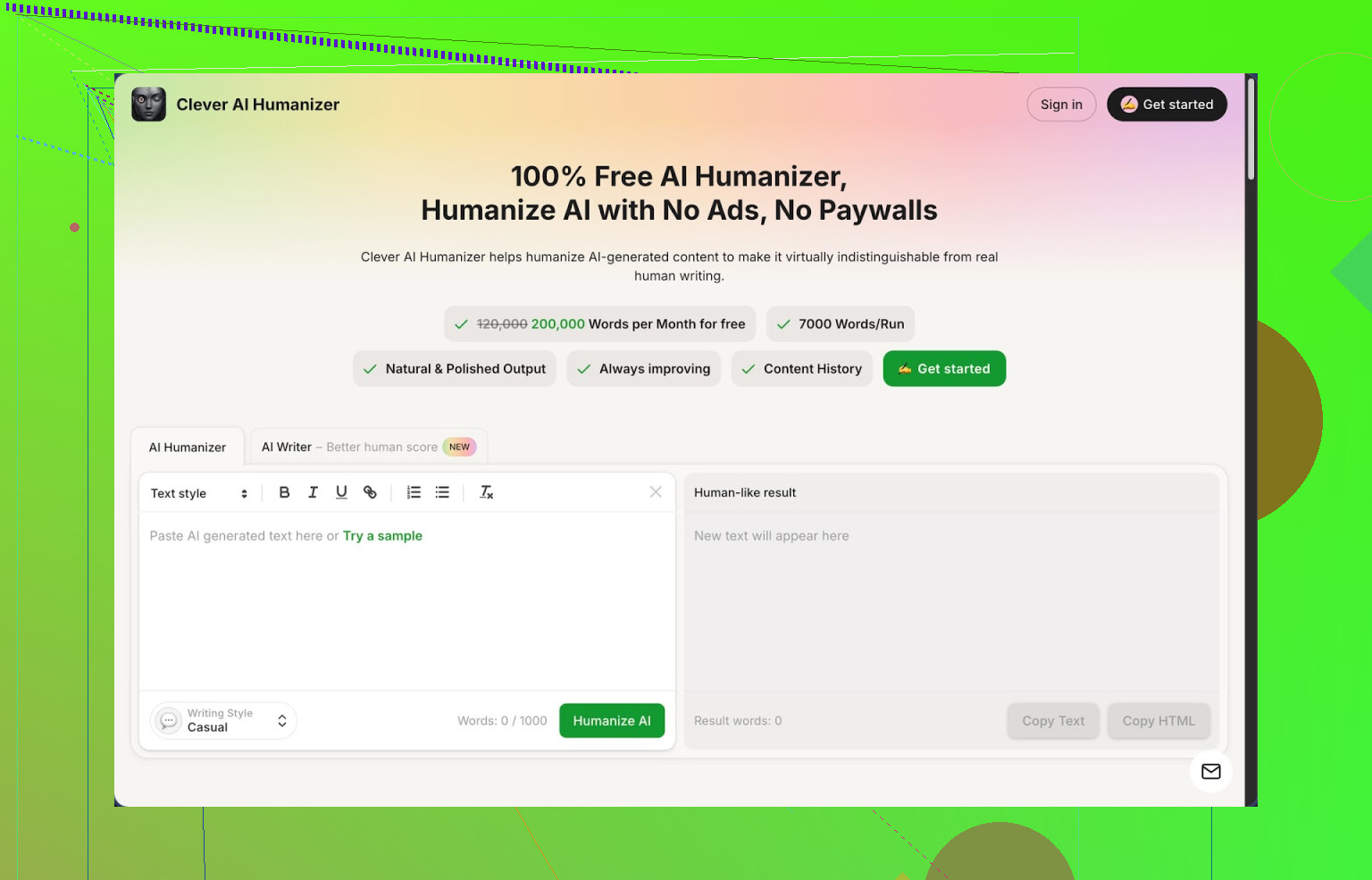
Clever AI Humanizer looked like one of those throwaway tools to me at first, but I ended up using it way more than I expected. The short version of what I noticed: it is free, the limits are high enough for real work, and the output passes a lot of common AI checks if you do not abuse it.
Here is what the free tier gives you right now: about 200k words each month, up to around 7k words per run, three tones to pick from (Casual, Simple Academic, Simple Formal), and an AI writer that lives in the same interface. No credit system, no paywall popup every second action.
I started testing it because I was tired of pasting text into detectors and watching them scream 100 percent AI on stuff that looked fine to me. I pushed several samples through Clever AI Humanizer using the Casual style, then ran them through ZeroGPT. Those came back as 0 percent AI on that specific detector. That surprised me, so I tried a few more batches, same pattern.
I would not trust any single detector as a judge of truth, but if your teacher or client uses ZeroGPT, this matters for you.
Let me walk through how I used it, step by step.
The main tool is the Free AI Humanizer. You paste the AI draft, pick a style, hit the button, and wait a few seconds. The rewrite strips out a lot of the robotic phrasing and weird repetition. It tends to smooth the flow and tweak sentence rhythm. The meaning stayed intact in most cases, at least in my tests with essays, how‑to posts, and a couple of product explainers.
The higher word limit is what made it usable for longer pieces. I took a 5,000 word doc from ChatGPT, ran it in one pass, then did a second pass on only the stiff paragraphs. No errors, no cap warnings.
What I liked most: it does not wreck the structure. Headings stayed in place, bullet lists stayed lists, quotes survived. I have tried tools before that inflated a 1,000 word post into this bloated 1,800 word wall where every line sounded like a sales pitch. This one stayed closer to the original size, even though the humanized version often ended up a bit longer.
Once I got used to the main humanizer, I started poking at the other stuff they tucked into the same site.
The Free AI Writer is a basic generator. You drop in a topic, add a short prompt, it spits out an article or essay. The useful part is that you can run the generated text through the humanizer in the same flow, so you do not have to jump between tools.
For example, I asked it for a short blog post on data backups for home users, then humanized that draft using Casual style. The raw output from the Writer felt like any other generic AI draft. After humanization, it came off closer to something a junior copywriter would send you. On ZeroGPT it also showed as human text.
Next, the Free Grammar Checker. I pushed both native human writing and AI‑assisted drafts through it. It caught common stuff: punctuation slips, run‑ons, odd phrasing. It does not feel as picky as tools like Grammarly, but for quick cleanup before sending an email or publishing a post, it did the job.
The Free AI Paraphraser Tool is more niche but still useful. I used it when I wanted alternative wording for short blocks, mostly for SEO rewrites and for trimming overcomplicated sentences. It keeps the same idea and flips the language. I would not use it to rewrite entire articles wholesale, but for fixing specific lines it saved some time.
The main upside is that all four parts live in one place: humanizer, writer, grammar checker, paraphraser. Same interface, same styling. I got into a simple loop for longer pieces:
- Draft with ChatGPT or the built‑in AI Writer.
- Run through the Humanizer in Casual or Simple Academic style.
- Fix problem paragraphs again with either Humanizer or Paraphraser.
- Finish with Grammar Checker before sending or publishing.
If you write daily for school, freelance work, or content jobs, that flow cuts a chunk of manual editing. At least it did for me.
It is not perfect though, so here is what bothered me or at least what you should expect.
- Some detectors still flag the text as AI. I tried Originality.ai and GPTZero on a few samples. Those were not as forgiving as ZeroGPT. Scores dropped compared to raw AI output, but they did not always hit safe territory.
- Humanized text often ends up longer. The tool likes to break up lines, add small clarifications, or rephrase with extra words. If you need to stay under a strict word cap, you might need to trim manually afterward.
- Occasionally it over‑simplifies. Technical language in some of my cybersecurity related snippets got toned down too much, so I had to restore certain terms by hand.
Even with those issues, for a free option with no aggressive upsell, I kept returning to it. For rough content, student essays, internal docs, or blog drafts, it felt good enough.
If you want a longer breakdown with screenshots and AI detector results, there is a more detailed writeup here: https://cleverhumanizer.ai/community/t/clever-ai-humanizer-review-with-ai-detection-proof/42
There is also a YouTube review that walks through the interface and shows detector checks on screen:
Clever AI Humanizer Youtube Review https://www.youtube.com/watch?v=G0ivTfXt_-Y
If you want to compare it with other tools or see what people are saying about AI humanizers in general, these Reddit threads helped me get a better sense of what others tested and where the tools fail:
Best Ai Humanizers on Reddit: https://www.reddit.com/r/DataRecoveryHelp/comments/1oqwdib/best_ai_humanizer/
All about humanizing AI: https://www.reddit.com/r/DataRecoveryHelp/comments/1l7aj60/humanize_ai/
17 Likes
I had the same problem as you. Most “free” humanizers lock you after a few runs or mangle the tone so hard your text feels like someone else wrote it.
Couple of things that worked for me without repeating what @mikeappsreviewer already walked through.
- Clever Ai Humanizer as a NoteGPT-style replacement
If you want something close to NoteGPT’s AI Humanizer, Clever Ai Humanizer is the closest I’ve found that stays usable on the free tier.
Key stuff that matters for your use case:
• High free limit per month, so you handle full essays and reports.
• Keeps structure, headings, and bullet lists.
• Lets you pick tone so it does not auto-switch everything to “bloggy” marketing talk.
To keep your original meaning as much as possible, this workflow helped:
• Run smaller chunks, 1–3 paragraphs at a time, instead of huge walls of text.
The tool stays closer to the source when the input is short.
• Use the “Simple Academic” or “Simple Formal” tone for school or reports.
“Casual” sometimes adds extra filler lines.
• If a paragraph comes back too changed, paste both versions in again and instruct it to keep specific terms or phrases.
I disagree a bit with the idea you should always run full 5k+ words in one go. For detector evasion it might be fine, but if you care about meaning and your own voice, smaller passes give you more control and fewer weird shifts.
-
Mix humanizer + light manual edit
No online tool will perfectly “humanize” and keep 100 percent of your style.
What works:
• Let Clever Ai Humanizer remove the robotic patterns.
• Spend 5–10 minutes doing a manual pass where you:
– Put back any phrases that sound like you.
– Shorten any bloated sentences.
– Restore domain terms if it over-simplified them. -
For strict detectors or professors
If your teacher uses tools like GPTZero or Originality, do this:
• Humanize once in Clever Ai Humanizer.
• Then edit 10 to 20 percent of the sentences by hand. Change word order, cut a line, add a short example from your own experience.
Detector scores drop a lot when some lines clearly come from your brain rather than a uniform model style. -
What to avoid
From my tests, you want to skip:
• “SEO rewriter” tools that rewrite every single sentence. Those wreck meaning and tone.
• Tools that always expand text. Word count inflation is a red flag if you have strict limits.
• Extensions that auto-humanize in your browser. Harder to see what changed and fix it.
If your main goal is:
“Free, no constant paywalls, keeps structure, keeps meaning, looks less AI,”
then using Clever Ai Humanizer in small chunks plus a short manual cleanup is the most stable setup I’ve found so far.
If you want “NoteGPT vibe but actually free,” you’re kinda stuck mixing a tool + a workflow rather than finding a perfect one‑click clone.
I mostly agree with what @mikeappsreviewer and @reveurdenuit said about Clever Ai Humanizer, but I’d tweak how to use it:
-
Use Clever Ai Humanizer, but treat it like an editor, not a magic cloaker
- I actually like running longer sections (800–1500 words) instead of tiny 1–3 paragraph chunks.
- When you go too small, the style starts feeling choppy because each segment gets slightly different rhythms. With bigger chunks, the voice is more consistent and closer to “one human wrote this in one sitting.”
-
Lock in your own voice first
- Draft in your own style (even if it’s with AI), then do a quick manual pass before you humanize.
- Kill obvious “AI-isms”:
- “In conclusion,” “On the other hand,” “It is important to note,” etc.
- This alone already drops detection a bit and keeps your tone in place so Clever Ai Humanizer has less to “overfix.”
-
Use Clever Ai Humanizer settings strategically
- For what you want (meaning intact, no overfancy tone), I’ve had the best luck with:
- Simple Academic for essays, reports, instructions.
- Simple Formal for emails, proposals, anything “professional but not stiff.”
- If you pick Casual, it sometimes adds that “blog article” fluff you said you hate. I basically only use Casual when I’m writing marketing stuff.
- For what you want (meaning intact, no overfancy tone), I’ve had the best luck with:
-
Undo the “AI overhelpfulness”
After humanizing, do a fast 5–7 minute sweep and specifically look for:- Sentences that suddenly got a moral lesson or mini-summary at the end
- Extra “explanation” lines you didn’t ask for
- Over-simplified technical words (“endpoint security” turned into “protecting your devices”)
Just cut those. That keeps the meaning and restores some of your natural density.
-
Layered approach if you’re paranoid about detectors
If your prof or client is hardcore about GPTZero / Originality:- Humanize once in Clever Ai Humanizer.
- Then manually rewrite about 15% of the sentences:
- Merge two short sentences into one
- Split an overly long sentence into two
- Add 1–2 specific, real examples from your own life or project
Detectors hate irregular, personal detail + varied sentence lengths. That combo looks a lot more human than just “paraphrased AI.”
-
What not to bother with
- Those “AI undetectable” paid tools that promise 0% on every detector are mostly running heavy paraphrasers that wreck your structure and voice. They’re the reason essays suddenly sound like a Victorian butler.
- Browser extensions that auto-humanize as you type are a mess to debug. You never quite know which sentence got mangled where.
So yeah, if your checklist is:
- Actually free or generous free tier
- Keeps headings, lists, and structure
- Doesn’t inflate 800 words into a 2000-word Wikipedia clone
then Clever Ai Humanizer is honestly the closest to a NoteGPT AI Humanizer alternative I’ve found that’s still usable.
It won’t perfectly “keep your original style” out of the box, but pairing it with a light manual pass before and after gets you way closer than just slamming text through random “AI remover” sites.
Short version: there is no perfect “NoteGPT clone” that is 100% free, keeps your style, and auto-passes every detector. But you can get close with the right combo of tool + workflow.
Since @reveurdenuit and @mikeappsreviewer already broke down how to use Clever Ai Humanizer, I’ll focus on when it actually makes sense to use it, when it doesn’t, and what to pair it with.
1. When a humanizer is actually useful (and when it is overkill)
Where Clever Ai Humanizer really helps:
Good use cases
- You wrote with ChatGPT and the draft feels stiff or repetitive.
- You need to keep headings, lists, section flow.
- You want text to sound like a normal student/worker, not a content marketer.
Bad use cases
- You already write decently and only need light polishing. In that case, a basic grammar tool or short manual edit beats any humanizer.
- You are trying to 100% “evade” every detector. That is not realistic. Humanizers reduce risk, they do not give you immunity.
So I slightly disagree with the idea that everything should go through a humanizer by default. If your original draft already passes a sniff test and only a few phrases scream “AI,” a straight manual cleanup is faster and safer.
2. Pros and cons of Clever Ai Humanizer for your specific need
You said: “keep my original meaning and structure, don’t sound super AI, and stay actually free.” On that checklist:
Pros
-
Generous free tier
Around 200k words a month is more than most students or solo workers will hit, and you can process long essays in one go. -
Structure preservation
It is much better at keeping headings, bullets, and quotes intact compared with generic paraphrasers. For reports or assignments, that is a big plus. -
Tone options that are not all “blog content”
Simple Academic and Simple Formal help reduce that fake marketing vibe that so many tools inject. -
Built-in ecosystem
Having humanizer, writer, grammar checker, and paraphraser in the same interface is nice if you want to stay in one place.
Cons
-
Not a style clone of you
It will never perfectly mimic your voice. It tends to normalize phrasing. If your natural writing is quirky or strongly personal, you must add that back by hand. -
Can inflate text and soften technical terms
It sometimes lengthens explanations or replaces precise domain jargon with softer phrases. For technical or academic work, you must restore key wording. -
Detectors still not guaranteed
As others pointed out, some detectors show big improvement, some still flag parts. If you are in a strict environment, you still need a manual layer on top. -
Mild “polish smell”
After using it a while, you will start noticing its own subtle rhythm. If you run huge volumes of text through it unchanged, they begin to share the same feel.
3. Where I diverge from other workflows
-
@reveurdenuit prefers small chunks. @techchizkid went more with longer blocks for consistent voice.
My take:- For pure essays / reports, I side more with longer sections, around 800–1500 words, so the flow feels natural.
- For high‑stakes paragraphs (thesis, key argument, abstract), I would run them separately and edit harder by hand afterward.
-
I also think people overuse “Casual” styles in every tool. That is exactly how you end up sounding like a blog post you never intended to write. For school or formal tasks, Casual is rarely the best default.
4. How to make any humanizer less necessary
If you want to reduce tool dependence:
-
Kill obvious AI phrases at the draft stage
Before sending anything into Clever Ai Humanizer, sweep out repeated crutches like:- “It is important to note that”
- “In today’s world”
- “In conclusion”
- “On the other hand” at the start of every second paragraph
-
Inject specific details only you would say
A single sentence with a real example, a local reference, or a personal memory changes the feel of a piece more than a full machine rewrite. -
Vary sentence length manually
AI leans toward mid-length, clean sentences. Insert a few short, blunt ones and a couple of more complex ones that still read clearly.
Do that first, then humanize if you still feel it sounds robotic. Half the time, you may realize you don’t even need the tool.
5. Positioning Clever Ai Humanizer among alternatives
Since you already heard from @reveurdenuit, @techchizkid, and @mikeappsreviewer, you’ve basically seen the “this is the best middle-ground right now” argument.
My angle:
-
Clever Ai Humanizer is worth using when:
- You care about preserving structure.
- You want an actually usable free tier without a paywall ambush.
- You are okay doing a 5–10 minute manual pass afterward.
-
It is not a swap-in brain that writes like you.
It is more like a strong first editing pass that reduces “AI flavor,” after which you must repaint the parts that matter.
If you accept that limit, it becomes a genuinely useful NoteGPT-style stand‑in rather than another overhyped “AI undetectable” gimmick.