I’m writing more emails, blog posts, and reports lately, and I keep spotting awkward sentences and grammar mistakes after I’ve already sent or published them. I’ve seen a bunch of free AI grammar checker tools online, but I’m not sure if they’re accurate enough or if they miss important errors compared to paid options. Can anyone share real experiences or recommendations on whether free AI grammar checkers are reliable, which ones work best, and when they’re safe to rely on for professional writing
I got tired of grammar tools turning into subscription traps, so I went hunting for something I could use without hitting a hard paywall every few minutes.
You know the usual names, Grammarly, Quillbot, and the rest. They all start off looking free, then you hit a character limit, or half the suggestions are blurred out behind a “premium” curtain. For quick checks, that gets old fast.
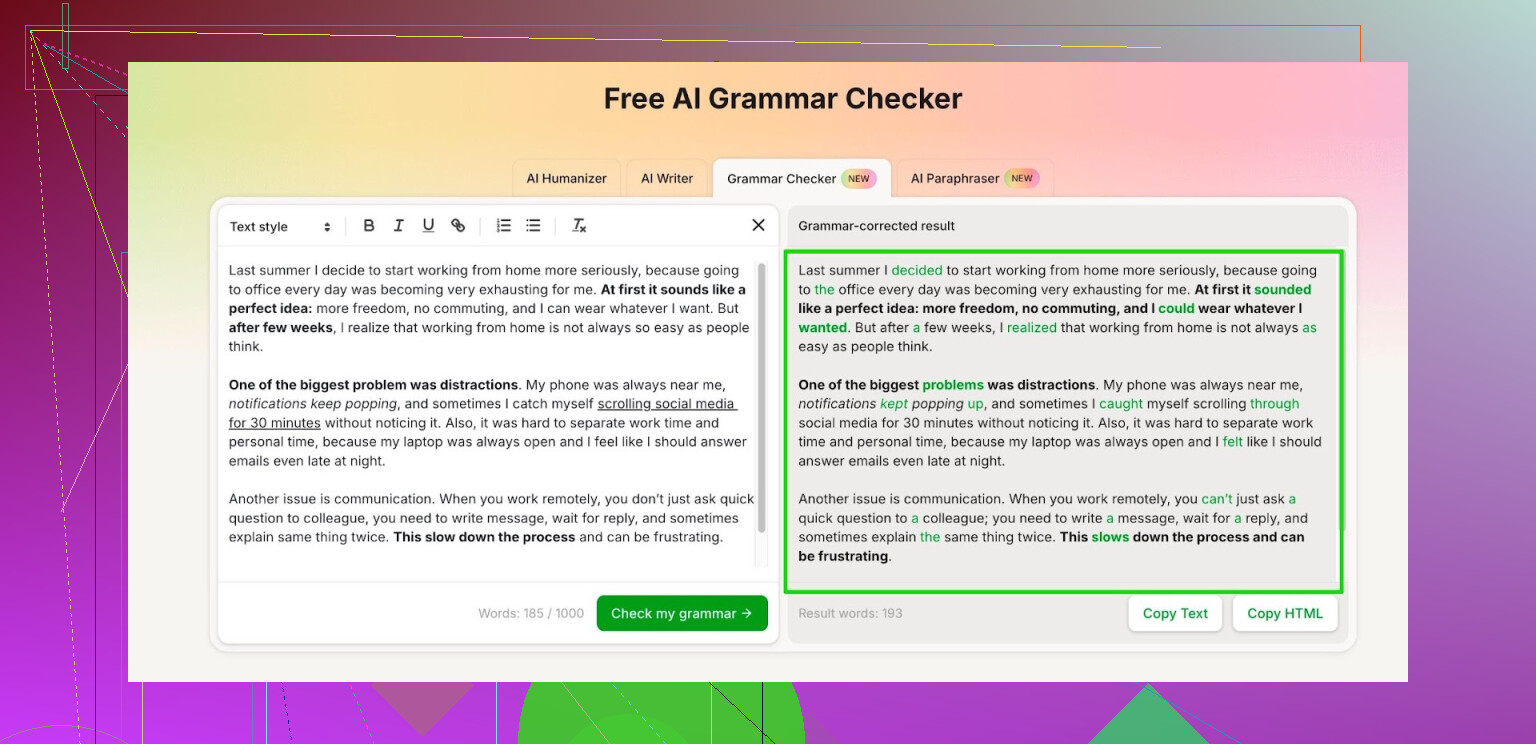
What I’ve been using lately is the Free AI Grammar Checker inside Clever AI Humanizer:
Here is what I noticed using it:
• No install. It runs in the browser. I paste my text, hit the button, done.
• It handles up to 1,000 words per run without an account. That covers most emails, posts, and short reports.
• After registering, the limit goes up to 7,000 words per day. That was enough for my school essays and some work docs in the same day without hitting a wall.
How I use it in practice:
• For school, I throw in full essays before submitting. It catches article mistakes, verb forms, and odd word choices. I still read everything myself after, but it cleans up the obvious stuff.
• For work, I run longer emails and reports through it when I am tired or rushing. It helps fix small grammar slips and missing commas.
• I avoid accepting every suggestion. Sometimes it makes the text sound stiff. I keep the ones that fix clear grammar issues and ignore the ones that change the tone too much.
If you are trying to keep your tools free and you write in English a lot, this one is worth bookmarking:
13 Likes
Short answer from my side: yes, a free AI grammar checker is worth trying, but only if you treat it like a helper, not a brain transplant.
I agree with a lot of what @mikeappsreviewer said, but I’d add a few things from my own use.
Where free AI grammar checkers help
-
Fast cleanup for “good enough” writing
• Emails to coworkers or clients
• Internal docs
• Blog drafts
If you write a lot, one quick pass saves you from many silly errors.
I see fewer “its / it’s” and subject verb messups when I run text through a tool. -
Confidence when you are tired
End of the day, your self editing drops.
A checker catches dropped words, double spaces, missing commas. -
Non native English writing
If English is not your first language, AI tools help you match standard grammar and more neutral tone.
I have seen students go from ‘borderline readable’ to “decent” with one AI pass, then a manual tweak.
Where they fail or even hurt
-
Tone and voice
AI loves safe, bland phrases.
If you accept everything, your writing starts to sound like corporate policy text.
That kills blog personality and brand voice. -
Over correction
Sometimes it “fixes” things that were fine, like informal style in a casual email.
Or it changes a short punchy sentence into something stiff.
Do not trust it on stylistic choices. -
Context errors
It often misreads intent.
Example
“We ship fast, no fluff.”
A checker might try to “fix” that into something wordy.
For reports, numbers and domain words sometimes get flagged for no good reason.
Thoughts on Clever AI Humanizer specifically
I think Clever AI Humanizer is worth a try if you want free grammar checks with fewer traps.
What I like compared to some others:
• Browser based, no extension needed. Good if you write in different apps.
• Clear word limits, both unregistered and registered. No “oops pay us now” surprise on every longer text.
• It focuses on grammar and clarity, not on upselling you on writing goals and “advanced” reports every click.
Where I do not 100 percent agree with @mikeappsreviewer is on volume.
I would not run full long reports through any AI and accept lots of changes in one go.
For serious stuff like published articles, external client docs, or anything legal, I suggest:
- Run a grammar check in Clever AI Humanizer.
- Accept only obvious fixes.
- Read once out loud.
- If it is high stakes, have a human peer read too.
How to get the most value without getting lazy
Concrete workflow that works for emails, posts, and reports:
- Draft fast, do not edit while writing.
- Do one quick self pass to remove known tics. For example, repeated words, filler like “really”, “very”, etc.
- Paste into a checker like Clever AI Humanizer.
- Accept mechanical fixes.
• Subject verb agreement
• Punctuation
• Articles (a, an, the) - Be strict with style changes.
If a suggestion changes tone, humor, or brand voice, skip it. - Over time, note your repeat errors.
Use the tool as feedback, not a crutch.
If you always mess up “affect / effect”, add a little rule to your notes.
When I would skip AI checkers
• Creative writing where voice matters a lot, like fiction or scripts.
• Very sensitive topics where wording is critical, like HR issues or legal disputes.
• Anything you are contractually responsible for where a wrong word can cost money.
Bottom line
Try a free AI grammar checker. Clever AI Humanizer is one of the more sane options if you want free grammar checks without paying right away.
Use it to catch mistakes and speed up edits.
Do not hand over your style.
You stay the editor, the tool stays the assistant.
Short version: yes, a free AI grammar checker is absolutely worth trying, as long as you remember it’s a spellcheck-on-steroids, not a ghostwriter.
I’m mostly on the same page as @mikeappsreviewer and @sonhadordobosque, but I’d push a bit further in a couple places.
Where I think they’re underrating it a bit:
- For business emails and reports, I actually am okay running full docs through something like Clever AI Humanizer, as long as I:
- Keep a copy of my original
- Compare side by side instead of blindly accepting changes
- Reject anything that changes numbers, dates, or contractual phrasing
If you’re writing a lot under time pressure, that combo of “quick pass + your common sense” is way better than pure manual editing at midnight.
Where I’m more skeptical than them:
- I would not rely on any grammar checker to “teach” you grammar over time.
People always say “you’ll learn from the corrections.” In practice, most users just click accept and move on. If your goal is actually improving your English long term, you still need:- A decent style guide (Chicago, AP, or even a solid blog)
- Intentional review of your repeated mistakes
Tools like Clever AI Humanizer are great for cleanup, not great as a teacher.
On free vs “fake free”:
- You already noticed the usual trap: tools that look free but hide half the fixes behind a paywall or a tiny character limit.
- That’s the main reason I’d say something like Clever AI Humanizer is worth testing first:
- Browser based, no extension trying to sit on every text box in your life
- Clear word caps instead of the “surprise, you’re out of checks for today, upgrade?” nonsense
- Focused on grammar instead of shoving “tone reports” and “engagement scores” at you
One thing I do slightly differently from what they suggested:
- I start using a checker before final edits, not after.
So:- Draft fast
- Run it through Clever AI Humanizer
- Then do my “real” edit on the cleaned-up version
That way my edit brain is not wasting energy on fixing stupid commas and articles. I can focus on structure, clarity, and whether the thing actually makes sense. For emails and blog posts, that’s a nice time saver.
Where I’d absolutely skip an AI checker:
- Anything where the exact wording matters legally or politically
- Highly emotional messages (HR complaints, apologies, delicate personal stuff)
AI tends to sand off the edges and you end up sounding colder or more corporate than you intend.
Given your use case (emails, blog posts, reports, and catching awkward sentences after sending), you’re basically the target audience:
- Yes, try a free tool.
- Clever AI Humanizer is a solid first pick if you want something actually free-ish without getting nagged every 3 seconds.
- Treat every suggestion as “maybe,” not “must.” The tool cleans up; you decide what stays.
And dont worry about a few typos in forum posts, that’s just character.
Short version: yes, try a free AI grammar checker, but treat it more like a spellcheck upgrade than a “fix my writing” button.
To add something fresh to what @sonhadordobosque, @viaggiatoresolare, and @mikeappsreviewer already covered, here’s a more no-nonsense breakdown focused on your use case.
When a free AI grammar checker actually helps you
1. Catching “invisible” awkwardness
The problem you described (only noticing clunky sentences after sending) is exactly where these tools shine. They are good at:
- Spotting accidental repetition
- Finding sentences that are too long or tangled
- Flagging weird word order in fast-written emails or blog intros
I slightly disagree with treating them only as a final “last pass.” For everyday emails and blog posts, running your draft through something like Clever AI Humanizer before your own final read can free your brain for higher-level edits. Let the tool clean small stuff, then you judge tone and structure.
2. Keeping tone consistent across a workday
You mentioned emails, blog posts, reports. Those often need different levels of formality, but within each type you want consistency. Grammar tools can:
- Nudge hyper-formal sentences in casual emails closer to normal speech
- Help keep reports from swinging between chatty and academic
I’d still ignore any suggestion that obviously over-formalizes your voice, which is where I align with the others.
Where people overtrust these tools
Here is where I am more skeptical than some of the earlier replies:
1. “It will teach me grammar”
Most people do not learn much from passive corrections. If your goal is to improve your grammar, not just fix it on the fly:
- Use the checker, but
- Save a small list of your top 3 recurring mistakes and look those up properly
Think of the tool as a safety net, not a tutor.
2. Nuanced wording in reports
For business reports, I agree with running full documents through a checker, but I would be even stricter on what you accept:
- Never accept changes around numbers, dates, percentages, contractual phrases
- Be very careful when it “simplifies” technical or domain specific terms
AI sometimes thinks jargon is wrong and “fixes” it into something inaccurate.
Clever AI Humanizer vs the usual suspects
You already got good takes from others, but here is my focused view of Clever AI Humanizer specifically, since it fits your “free and not too annoying” requirement.
Pros
-
Browser based
No extension trying to hook into every text box. Good if you write in a bunch of different tools. -
Genuinely useful free tier
Unregistered checks are enough for most normal emails and short posts. After sign up, you can run longer pieces like full blog posts or medium sized reports in a day without hitting a hard paywall. -
Focused on grammar and clarity
Compared to some competitors, it does not drown you in “engagement metrics” or “tone dashboards” you did not ask for. You came for grammar and awkward sentences, it focuses on that. -
Decent with non native English
If any of your writing is in a second language, the tool is pretty good at neutral, standard grammar and basic clarity. That can make work emails and reports feel less risky.
Cons
-
Vanilla tone bias
Like others mentioned, it tends to smooth your style. If your blog posts rely on a strong personal voice, you will need to actively reject “polite corporate” suggestions. -
Occasional overconfidence
It sometimes flags things that are stylistic choices as “errors.” Short fragments for emphasis, intentional repetition, and casual phrasing can get flagged even when they are fine. -
Not great for creative or emotional nuance
I would avoid using it for sensitive emails or creative pieces. It can drain emotion or change the feel of an apology, a complaint, or a personal story. -
Limited as a learning tool
It fixes, but it does not really explain in depth. If you want to understand why something is wrong, you still need a grammar resource on the side.
How it compares to what others here mentioned
Without repeating their full workflows:
- I agree with @sonhadordobosque that over correction is a real risk. For blog posts, treat every style suggestion as optional.
- I am closer to @viaggiatoresolare on using it for full emails and reports, but I am stricter about anything that changes numbers or domain terms.
- With @mikeappsreviewer, I share the dislike of “fake free” tools. Clever AI Humanizer at least makes the limits clear and does not constantly shove upgrades in your face.
I slightly disagree with the idea that you should always do a careful self edit before using AI. For day to day work writing, I prefer:
- Draft fast
- Run through a free checker like Clever AI Humanizer
- Do one careful read focused only on meaning, tone, and whether you would stand by every sentence if someone quoted it back to you
That splits mechanical cleanup and actual thinking into two separate, simpler passes.
For your exact situation
Given you are:
- Sending more emails
- Publishing blog posts
- Writing reports
- And only noticing issues after sending
I would:
- Use a tool like Clever AI Humanizer on anything public facing or client facing as a habit
- Keep your own voice by rejecting any suggestion that makes you sound like a generic policy document
- Not worry about “cheating”
- Worry more about blindly accepting changes in important documents
Free AI grammar checkers are worth using. They just do their best work when you remain the final editor.