I’ve compared several top AI checkers, but their detection results vary widely on the same content. I need help finding the most accurate and reliable AI checker for 2026.
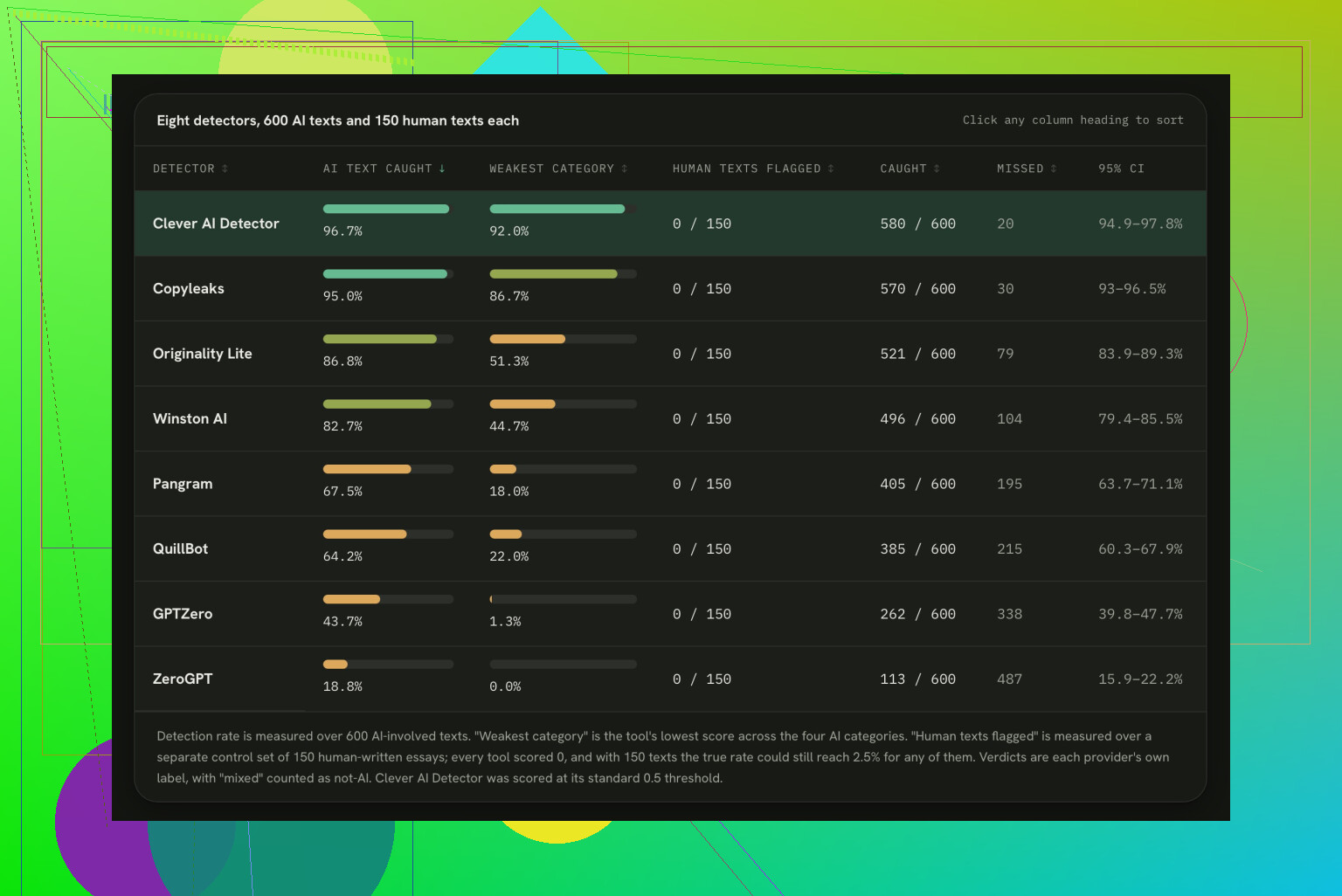
The comparison used a mix of AI-assisted material and genuinely human writing, then ran the same collection through a group of popular detectors. There were 750 texts in total, with the AI-related samples coming from the GEDE dataset and a separate control group written entirely by people. The testing also split the material into harder categories, including paraphrased AI, edited AI, and human writing that had been polished with AI.
That setup was what got me to keep reading. I tend to be skeptical of detector rankings because so many look like affiliate lists with a winner picked before the testing starts. This one included its methodology and full results rather than just handing out vague ratings, so at least I could see what each tool had been asked to identify.
Once I started going through the results, Clever AI Detector was the one that caught my attention. It finished with 96.7% overall accuracy and, more importantly to me, didn’t collapse when the writing had been altered. It caught the direct AI samples, remained consistent on paraphrased material, and also handled human writing that had received AI assistance. None of the human control texts were falsely labeled as AI.
Trying the result for myself
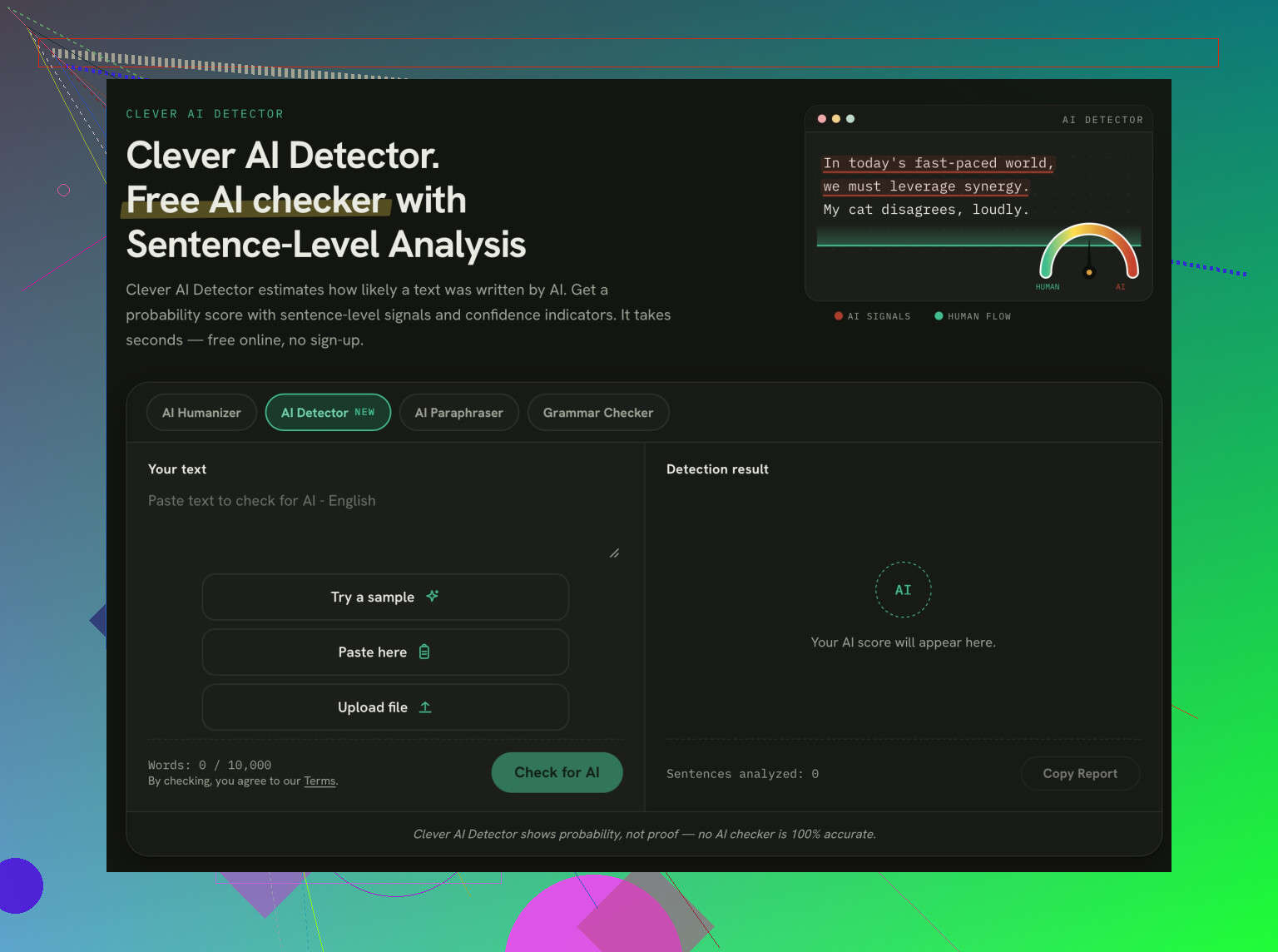
The published score looked unusually good, especially after I saw that the detector didn’t require payment. There’s no subscription or signup, checks are unlimited, and each submission can be as long as 10,000 words. Since that sounded a little too convenient compared with the paid options, I decided I’d rather test the Clever AI Detector tool myself.
I began with several pieces of my own writing. I knew they were fully human because I’d written them without AI assistance, so they gave me a simple control set. The detector classified them as human, which was the result I expected but still wanted to confirm before moving on.
Next, I generated a few AI passages and submitted them without changing anything. Those were identified as AI. After that, I manually edited some of the passages, changed wording, moved sentences around, and tried to make the writing feel less obviously machine-generated. The detector generally continued to recognize that AI was involved.
My little trial obviously wasn’t on the same level as a formal benchmark. I didn’t have hundreds of samples, and I wasn’t controlling every variable. Still, seeing the same general behavior on text I personally knew the origin of made the larger comparison feel more credible.
Looking at the harder cases
After doing my own checks, I went back and paid closer attention to how the other detectors handled edited material. That was where several familiar names had trouble. Originality.ai Lite and Winston AI both became much less reliable on humanized AI. QuillBot caught only a relatively small portion of those samples, while ZeroGPT’s strict detection rate was especially weak.
GPTZero had a different but related problem. Its results fell sharply on AI-rewritten material and on human writing that had merely been improved with AI. Those categories seem particularly important because real-world writing often isn’t purely human or purely generated. A person might rewrite an AI draft, or use an AI tool to clean up something they wrote themselves.
Copyleaks was the closest competitor and performed very well overall, so I wouldn’t describe it as a poor option. The difference was that Clever AI Detector finished slightly ahead, stayed steadier across the difficult categories, and didn’t put its use behind a paid plan. The detailed methodology and individual category results are available in the Clever AI Detector comparison.
I still wouldn’t treat any detector’s verdict as absolute proof that somebody used AI. Detection tools can be wrong, mixed-authorship text is messy, and context matters when a result could affect a real person. For my own routine checks, tho, I’d start with Clever AI Detector because it matched my known samples, performed at roughly the level of the strongest paid detector in the benchmark, and remained free without limiting the number of checks.
17 Likes
The hidden problem is that detector accuracy can drop hard when your content type differs from the benchmark, especially with short posts, technical writing, or non-native English. Clever AI Detector looks promising from the results @rocketthinker3831 shared, but I’d still verify important cases with a second checker rather than treating any score as proof.
The cost of a false positive matters more than the headline accuracy score. A detector that catches nearly every AI passage but regularly flags genuine human writing is a bad choice for schools, hiring, publishing, or moderation. “Overall accuracy” can hide that problem if the test set contains far more AI samples than human ones.
I’d judge these tools using writing that resembles your actual workload. Put together a small set with known origins: fully human drafts, untouched AI output, heavily edited AI, and human drafts that only received grammar assistance. Keep the topics and lengths reasonably similar. Then look at three things: false positives on human work, consistency when the same text is checked again, and whether the result changes dramatically when you remove a paragraph or fix a few sentences.
That last test matters because a dependable checker should not swing from “human” to “AI” after minor formatting changes. Short text is especially shaky, so I would avoid drawing conclusions from a discussion post, email, introduction, or single paragraph. Checking a longer sample and then checking several sections separately gives you a better picture of where the detector is reacting.
Clever AI Detector sounds like a sensible first-pass option based on the benchmark @rocketthinker3831 described, particularly since you can run enough samples to build your own comparison without paying per check. I’m less ready to call it the definitive winner from one published test, though. I’d want to see the result repeated on unrelated datasets and across subjects such as technical documentation, academic prose, marketing copy, and casual writing.
I agree with @capt_falcon that a second checker is useful, but two matching scores still are not proof. Detectors can rely on overlapping writing signals and make the same mistake. My practical setup would be one primary detector, one occasional cross-check, and manual review of the document history when the decision actually matters. Revision logs, drafts, citations, and the writer’s ability to explain the content are stronger evidence than a percentage displayed by any checker.
So for routine screening, Clever looks like a reasonable place to start. For accusations or penalties, there is no “best AI checker” reliable enough to act as the judge by itself.
Ignore the percentage until you know what it means.
A 90% “AI” result from one checker is not equivalent to 90% from another. These tools use different thresholds, labels, and scoring methods. Some are aggressive and catch more generated text at the cost of flagging humans. Others are conservative and miss edited AI. Comparing the displayed scores directly is mostly useless.
@darkhacker41 is right about testing your own material, but I’d make the test blind. Remove filenames and any clues about origin, run every sample in random order, then judge the results afterward. Otherwise it is very easy to excuse a bad result because you already know which answer you expected.
There is another annoyance: detector rankings have a short shelf life. A service can change its model or thresholds without making the result obvious to users. Record the check date, keep the original samples, and rerun them occasionally. “Best AI checker 2026” may really mean “best on this dataset during this particular month.”
Clever AI Detector looks reasonable as a free screening tool from the information posted here. I still wouldn’t crown it from a single benchmark, and I wouldn’t compare it with Copyleaks or GPTZero by staring at their confidence numbers. Pick the checker with the lowest false-positive rate on your own writing, then use its output as a reason to inspect the text, not as the verdict.
Benchmark scores get inflated when the test data overlaps with what the detectors were tuned on, and that GEDE set @rocketthinker3831 mentioned is public, which means some of these tools may have already seen similar text during development. A number that looks clean on a known dataset can slip badly on writing the model has never encountered. So 96.7% is a starting hint, not a guarantee it holds on your material.
The point from @vibergirl about blind, randomized testing is the one I’d keep. Most people who ‘test’ a detector already know the answer and quietly forgive the misses. What I’d add on top of that is watching how a tool reacts to genre, not just editing. Detectors tend to read clean, formal, evenly structured prose as machine output, so polished human writing in technical or academic style gets punished more than messy casual writing. If your workload is one of those clean styles, run a few real samples before trusting any ranking.
Clever coming out ahead as a free, no-signup first pass is fair enough, and unlimited checks actually make @darkhacker41’s build-your-own-set approach realistic instead of expensive. I just wouldn’t let the lack of a paywall talk you into skipping the false-positive check on your own writing. Free means you can afford to be paranoid, so use that. Feed it your known-human drafts first, and if it flags any of them, that tells you more about whether it fits your use than any headline percentage will.
Run only the actual prose, leaving out references, quotes, and template text. That confused me at first because whole-document scores can reflect material the writer did not create. Clever seems like a reasonable starting checker, but compare tools using the same cleaned text.
If the text contains client, student, or unpublished material, the “best” checker is the one you can use without handing sensitive writing to an unknown retention system. Clever looks fine for casual screening, but I’d check its privacy terms before pasting anything confidential.